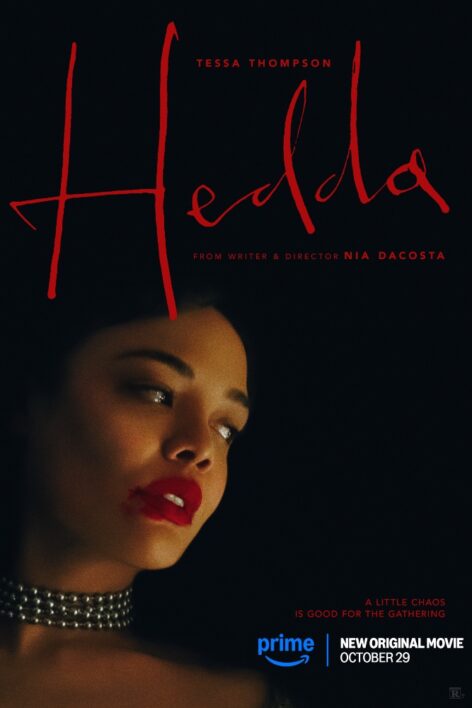
“Hedda” is in Select Theaters on October 22nd and On Prime Video October 29th.
Today UB has an Extended Preview!
Directed and written by Nia DaCosta. Based on “Hedda Gabler” by Henrik Ibsen.
A provocative reimagining of Henrik Ibsen’s classic play, “Hedda” follows enigmatic newlywed Hedda (Tessa Thompson), who is outwardly composed but hiding a simmering discontent that threatens to explode when the brilliant and charismatic Eileen Lovberg (Nina Hoss) reenters her life.
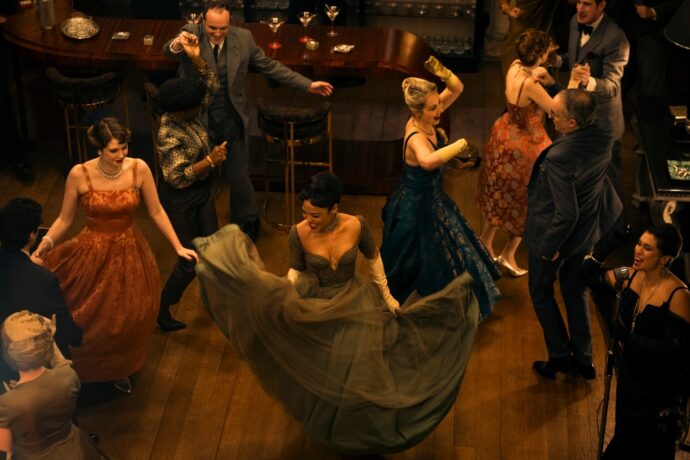
Over the course of a raucous party, the high and low of society endure the consequences of this dangerous and unknowable woman yearning for a past love. What ensues is a ruthless game of manipulation, where lust, jealousy, and betrayal collide.
“Hedda” is a daring exploration of power, desire, and a woman’s refusal to be confined.
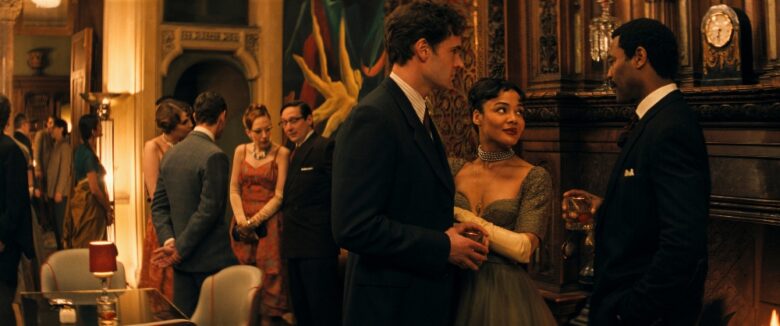
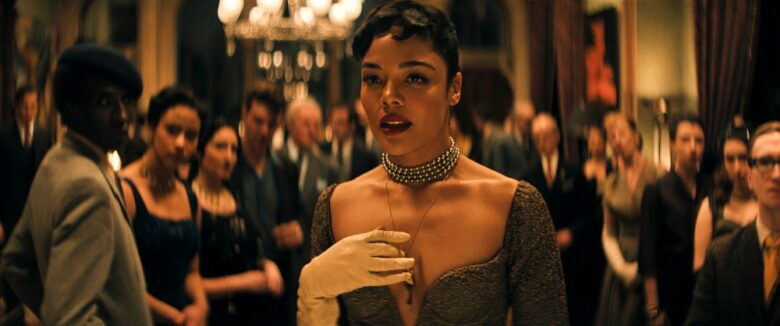
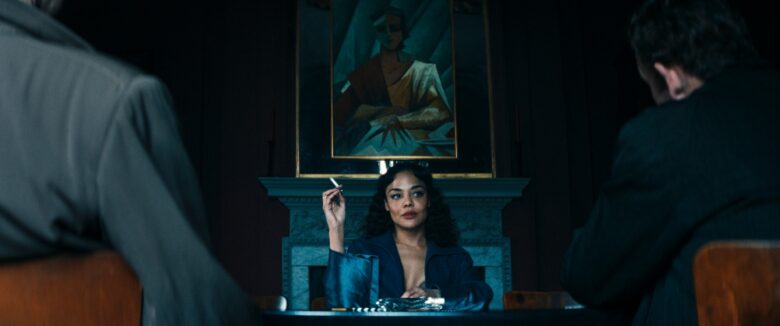
(L-R) George Tessman (Tom Bateman), Hedda Gabler (Tessa Thompson) and Judge Roland Brack (Nicholas Pinnock) in HEDDA.)
Power, status, fear, and desire uncork a night of deadly mind-games as a glamorous socialite’s over-the-top dinner party goes wildly off-the-rails.
The alluring newlywed Hedda Gabler is about to throw an all-out bash hoping to expand her social influence. But as champagne flows and fireworks spark, so too do passion, manipulation, and fury, building to a series of wrenching shocks.
With “Hedda,” writer-director Nia DaCosta reimagines one of the great Bad Girl tales of all time as a provocative modern thriller. As portrayed by Tessa Thompson, this Hedda is a devilishly smart, if dangerously frustrated, woman of ambition.
She’d rule the world if only she wasn’t trapped by a man she doesn’t love, a lavish house she can’t afford, and a world that blocks her path. But she also has an extreme allergy to boredom. And at the glam affair she’s throwing on her husband’s behalf it all comes to a head, sparked by a threatening visitor from her past.
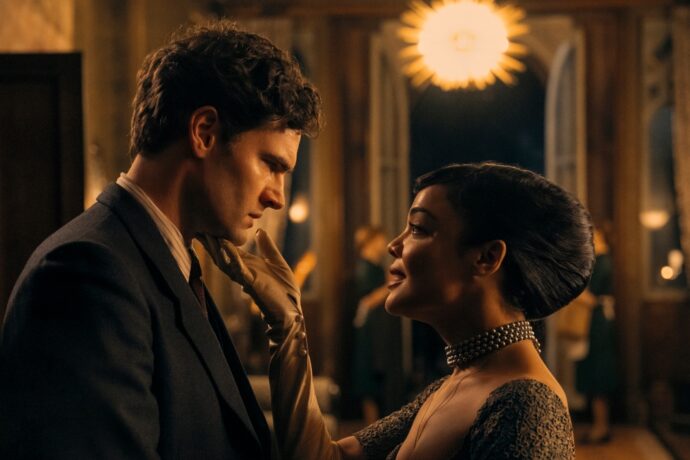
(Tom Bateman (George Tessman) and Tessa Thompson (Hedda Gabler) in HEDDA)
Driven to lash out against all that holds her back, but also quench her thirst for more, “Hedda” turns her party haywire.
Long an icon of mad yearning, “Hedda” is a dreamer, a schemer, and a woman terrifyingly determined to be who she wants at any cost.
Says writer-director DaCosta, “Deep down what Hedda really desires is love, to feel wanted and respected. But on this night, she chooses power and control over love.”
DaCosta first burst onto the scene as a riveting new filmmaking voice with the stylish crime thriller “Little Woods” (starring Thompson), then switched gears with the horror hit “Candyman,” before becoming the first Black woman to direct a Marvel feature with “The Marvels.”
Next, she also has “28 Years Later: The Bone Temple” in release, which she directed from a script by Alex Garland.
But with “Hedda,” DaCosta heads into territory unlike any she has explored. “One of the great problems of our time, and maybe just of being human, is how easily we replace the need for love with the need for achieving power. In their own ways every character in this story, but especially Hedda, falls into that trap. With ambition and lust driving their emotions, in the end, all this chasing after power is their downfall.”
Say Thompson of DaCosta’s take, “I’ve always believed when you adapt a classic work, you ought to put real skin in the game. And Nia was fearless. She so smartly set the story in the 50s with all its social constraints and compressed all the action into this one chaotic, pressure cooker of an evening, which makes it completely electric.”
With a crack cast and crew at her disposal, DaCosta took on the story’s teetering love quadrangle with both a savage wit and ceaselessly rising tension.
Producer Gabrielle Nadig who has worked with DaCosta from the start of her career describes, “Hedda is an invitation to a glamorous party that has at its center a sexy, dangerous woman who engineers an incredible train wreck.”
Starring; Tessa Thompson, Imogen Poots, Tom Bateman, Nicholas Pinnock and Nina Hoss.
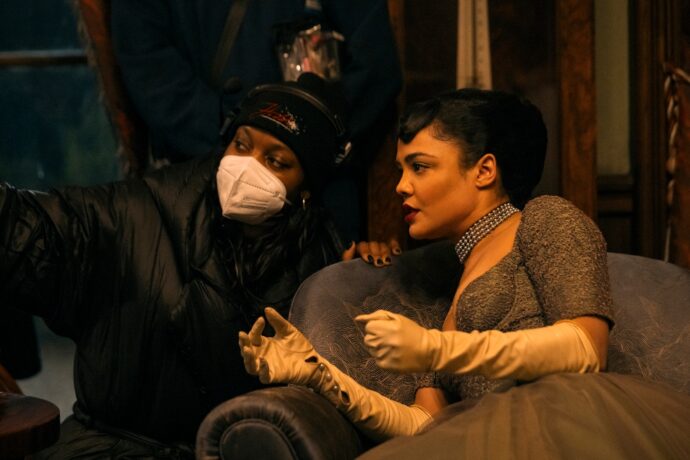
(Director Nia DaCosta and Tessa Thompson on the set of Hedda)
Nia DaCosta | Director’s Statement
My first time reading Henrik Ibsen’s Hedda was a revelation. Dark, funny, tragic, insightful, gonzo, sexy and honest. It was a look into the gnarled, needy heart of a mad and bad woman. And I loved her. I didn’t want to be like her, I thought the things she did were horrific, but in watching her strive, in her own way, for purpose and purchase in a life she hated, I saw a cracked mirror reflecting a struggle that many of us have—to be seen and understood even as we struggle to understand ourselves.
Soon after my first breathless reading of the play, I watched a production and all the things I loved about it weren’t quite there. Missing was the humor, the intentionality and the fun I read between the lines of Ibsen’s writing. It was watching this production that made me realize how I would want to adapt Hedda. Initially I thought I would do it for the stage, a big, brash production that made all the subtext text and pushed the bounds of the original story. But slowly, it became a film.
I think of Ibsen like Shakespeare or Jane Austen, it is classic drama that belongs to all of us and can be made in our image. Like turning Pride and Prejudice into Bridget Jones Diary, or Emma into Clueless or The Taming of the Shrew into Ten Things I Hate About You. Ibsen plays, in all their genius, are ripe for strong, characterful adaptations and that’s what I wanted to do with my Hedda. For a hundred years she has been the most unknowable and complex woman in theatre, so I choose a prism of this multifaceted person and shined a light through it. The first item on my agenda was to dig deeper into the themes of a woman finding agency, finding access to whatever they think freedom is, in a world that tells them they are not entitled to self-possession or power. To deepen this theme, I decided that Ejlert Lövborg would become Eileen.
Making Lövborg a woman meant I now had three women at the center of the story who have found different ways to be—or try to be—free. Hedda colors within the lines of society to get her way—marry a good enough man, make him give you the life you want (even though it makes her even more unwell than she already is). Eileen chooses her mind—be so brilliant that no one can tell you you’re not good enough (even though the constant fight leads her to drink). And Thea, perhaps the bravest of them all, chooses love, chooses truth—she leaves her husband for a woman and for a chance, just a chance, to be seen (and read).
It is these three women that animate my Hedda, alongside an ambitious, lonely Tesman and a wounded but still callous Judge Brack. Over one night in an English country house at a party the hosts cannot afford, Hedda follows these five people strive and hope and attempt to love. We hope they will all find their way to it, but will wonder by the end, if any of them really deserve it.
Produced by Dede Gardner, Jeremy Kleiner, Gabrielle Nadig, Nia DaCosta, and Tessa Thompson
Check Out The UB Previews – “I’m In Competition With That Women” and “Where Should I Start!”